Disciplining cats rarely stops unwanted behavior because punishment does not teach them what you want them to do instead. A more effective approach is to understand what is motivating the behavior, provide an acceptable alternative, and reward your cat for making the better choice.
by Rita Reimers, Certified Cat Behaviorist

How to Stop Unwanted Cat Behaviors
Cats don’t behave badly to spite us. Their actions usually serve a purpose, whether it’s scratching, playing, seeking attention, marking territory, relieving stress, or protecting themselves. Punishment can create fear and confusion without addressing the underlying need.
But here’s where things get tricky. Two cats displaying the exact same unwanted behavior may be doing it for entirely different reasons. What works for one cat may accomplish nothing for another, or even make the problem worse. Understanding what’s motivating your particular cat is the key to finding a solution that actually works.
Tried everything, but your cat’s behavior isn’t improving?
When unwanted behaviors persist, there’s usually more to the story than what you’re seeing on the surface.
As a certified cat behaviorist, I can help you identify what’s driving your cat’s behavior and develop
a plan that works for your household.
Explore cat behavior consultations for personalized guidance.
Why Cats Don’t Respond to Discipline

Disciplining cats means punishing them for doing things that often come naturally to them. Cats scratch to maintain their claws, stretch their muscles, and mark territory. These behaviors are part of their natural instincts, not deliberate attempts to misbehave.
Those instincts don’t disappear just because kitty lives indoors. Yelling or other forms of punishment won’t eliminate the underlying motivation.
Cats Don’t Understand Punishment
Cats don’t associate punishment with their actions the way humans or dogs might. If you spray them with water, they don’t think, “Oh, I shouldn’t do that.” Instead, they think, “Wow, my human is rude. I better plot revenge at 3 AM.”
Disciplining Cats Creates Fear, Not Learning

Punishing a cat can teach them to fear you, creating stress, anxiety, and potentially even more behavioral problems. I once had a client ask me, in all seriousness, “You mean I can never hit my cat?”
No, sir. It is NEVER okay to hit your cat.
And that was precisely the problem in this household. His cat had begun to associate his human with fear rather than safety. The aggression we were seeing wasn’t defiance or bad behavior. It was a cat trying to protect himself from someone he no longer trusted.
Why What You’ve Tried Isn’t Working
When you’ve tried everything you can think of and your cat’s behavior still isn’t improving, it’s easy to become frustrated. But the problem may not be what you’re doing. It may be that the behavior you’re trying to stop has an underlying cause you haven’t identified.
Two cats can display the same unwanted behavior for completely different reasons. Scratching, spraying, biting, or aggressive behavior may look similar on the surface, but what motivates each cat can vary considerably.
Until you understand what’s driving the behavior, you’re often treating the symptom rather than the cause. That’s why a solution that works beautifully for one cat may do absolutely nothing for another.
Disciplining Cats Can Escalate Unwanted Behavior

Some cats are downright sassy. But what looks like stubbornness or defiance may actually be a cat responding to stress, fear, frustration, or an unmet need.
When you try to discipline a cat, the behavior may not stop. In fact, it can sometimes become worse. A cat who feels threatened may become defensive, withdraw from interactions, or begin displaying other unwanted behaviors.
Punishment such as yelling, hitting, rubbing a cat’s nose in urine or feces, or spraying water can damage the trust between you and your cat. Instead of teaching an appropriate alternative, these methods may cause your cat to associate you with unpleasant experiences.
And here’s where things get complicated. What looks like the same behavioral problem in two different cats may have entirely different underlying causes. Without understanding what’s motivating the behavior, attempts to correct it can unintentionally make the situation worse.
 If you’ve ever caught your cat knocking something off the counter with the precision of a seasoned bowler, scratching furniture like they’re training for a WWE match, or launching a surprise ankle attack, you’ve probably wondered what on earth they’re thinking.
But before you blame your little troublemaker, remember that what looks like mischief to us often serves a perfectly reasonable purpose in your cat’s mind.
A Real-Life Example – How Disciplining Cats Often Fails

One of my clients sprayed her cat with water whenever she jumped onto the kitchen counter. The cat learned to stay off the counter while her person was watching, but she still went up there at night and whenever the house was empty.
The spray bottle had not taught her that the counter was off-limits. It had only taught her not to get caught.
The real question was why this particular cat found the counter so appealing in the first place. Was she looking for food, seeking a higher vantage point, or simply exploring? Understanding what motivated her behavior was the key to finding a solution that would actually work.
Still happening when you’re not watching? Stopping punishment is a good first step, but the next step depends on why your cat is doing it. I can look at your cat’s behavior, routine, and home to help you make a plan that fits.
Explore a private consultation for guidance tailored to your situation.
What to Do Instead
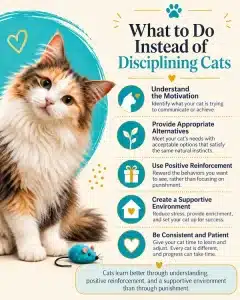
The answer isn’t to find a better way to discipline your cat. It’s to understand what’s motivating the unwanted behavior and address that underlying need.
Successful behavior modification involves several important principles, including redirecting natural instincts, using positive reinforcement, creating an environment that supports appropriate behavior, and maintaining consistency. But knowing these principles and knowing how to apply them to your particular cat are two very different things.
For example, two cats may scratch the same piece of furniture for entirely different reasons. One may be marking territory, another may be responding to stress, and a third may simply prefer the texture or location. Providing a scratching post might help one cat while doing little to change another’s behavior.
This is why there is no one-size-fits-all solution to unwanted cat behaviors. Your cat’s personality, history, environment, and relationships with other animals in the household all play a role. What appears to be a simple behavioral problem may have several contributing factors that aren’t immediately obvious.
And remember, a sudden or unexplained change in behavior should always be discussed with your veterinarian first. Pain and other medical conditions can cause aggression, litter box avoidance, restlessness, and other behaviors that might otherwise be mistaken for misbehavior.
The goal isn’t simply to stop your cat from doing something you dislike. It’s to understand why they’re doing it and find a solution that works for both of you.
Disciplining Cats: Final Thoughts

If you’re feeling like nothing you’ve tried is working, you’re not alone. It can be frustrating when you don’t understand why your cat keeps doing something you’ve tried so hard to stop.
But disciplining cats isn’t the answer. Understanding what’s behind their behavior is. And sometimes, having an experienced cat behaviorist look at the situation with fresh eyes can make all the difference.
After all, the goal isn’t to teach your cat how to avoid getting caught. It’s to help them make better choices, even when you’re not watching.