How Do I Get Him to be Nice?
Written by Cat Behaviorist Rita Reimers
 Help, My Cat Is Aggressive, what do I do?
I recently received a call from a very stressed kitty parent. She told me that her newly adopted cat, Barney, was acting aggressively toward her, her husband, and the other kitty in their household.
When I asked her to describe his behavior, what she told me may or may not have been aggression. She said Barney stalks and jumps at them, often grabbing ankles or jumping onto the back of their other cat, Bella. He never hissed or growled, he was just very physical and highly charged whenever he interacted with them.
 After visiting with them, observing Barney’s behavior with Bella, and interacting with Barney myself, I was able to clearly identify what was going on. Barney had play aggression; all he really wanted was to play.
This cat never had a home before; he grew up in the shelter living in a cage, and was never properly socialized. He had lots of pent up energy and lots to give, but he lacked the social skills needed to make friends with people or cats.
 Was he being aggressive? Yes, but not in the traditional meaning of the word. There are different types of cat aggression, and just as many different reasons why this behavior comes out.
More important than just seeing the aggressive actions, the circumstance around the behavior is what really tells the story. It’s easy to mistake play aggression for fighting aggression, unless you can identify the subtle differences.
What Cat Aggression Looks Like

What was my client seeing that lead her to think that Barney was being aggressive?
Barney was exhibiting a few of the classic characteristics of feline aggression:
- Stalking
- Chasing
- Grabbing
- Dilated pupils
 However, what made this PLAY aggression versus fighting aggression was the absence of:
- Biting
- Hissing and/or spitting
- Growling and/or screaming
- Low, Flat ears
- HUGE black eyes (ie: Full dilation)
- Showing of claws
Had this been a case of aggression that was about to become a fight, Barney would have been using his teeth and claws to attack once he jumped on the object(s) of his fixation.
Types and Causes of Cat Aggression
There are different types of aggression in cats, and many different reasons why they may react the way they do. Here are some of the most common types of aggression and what generally causes these reactions.
1) Play Aggression
 Usually seen in young kittens who are just learning proper social behaviors, kittens use their high energy to roughhouse with their littermates. These play sessions are also where kittens learn to hone their fine hunting skills by “stalking” and jumping out at one another. They also will scold one another when they play, scratch, or bite too hard. This is how they learn acceptable/unacceptable play behaviors. You might also see an improperly socialized adult cat exhibit play aggression, as in the case of Barney.
Humans may also unwittingly encourage aggressive play behavior by playing rough with their kittens using hands and feet instead of toys. It might be cute to let that sweet 3-month-old kitten bite your hands and toes, but it won’t be so funny when he is a full-grown cat.
2) Overstimulation
 Have you ever been petting your cat as she sits quietly in your lap, and all of the sudden she turns around and bites you? What happened? She became overstimulated and wanted you to stop. If you were distracted while petting her, you invariable missed the cues she gave you before she bit. There are always signs before the bite! Undoubtedly her eyes blackened, her ears went back, and her tail began to twitch wildly. She may have even given you a low growl. All these were signs to warn you that she was about to strike.
3) Fear
 Another common call I get: “I brought home a new cat, he is under the bed hissing and growling at me. Why is he doing that?” Its simple; he is scared. Think of everything your new cat has just been through. He was probably in a shelter, a rescue, or a foster home before you adopted him. Then perhaps he was taken to an adoption fair where he sat in a tiny cage feeling vulnerable.
Finally salvation, you come along and adopt him. If he were a person, he would understand that now he will have a great life. But he doesn’t know that, all he knows is now he is in a brand new place with new people and new smells, maybe even another pet is in the household. So your new cat reacts by telling you he is scared and by using aggressive behavior to make sure you don’t get too close until he is ready.
It’s a perfectly normal reaction, and given some time he will come around, once he gets accustomed to his new surroundings. (Tuna bribes work wonders to promote the bonding process!)
4) Food Aggression
 I have mostly seen this in tiny kittens, or cats that have been foraging for food outside for a long time. Kitten aggression over food happens when kittens are weaned too young. I will never forget when I brought 7-week-old Peanut kitten home (yes that is too young to be taken from momma cat!). I also had 8-week-old Boo-Boo and Pinky kittens at home, and it didn’t take long for them to become friends.
Until mealtime, that is. Tiny Peanut stood in the middle of the plate of wet food and growled as loudly as his little lungs would let him. The other two kittens were confused about this, but putting out a second food plate solved the problem. He did grow out of it eventually! As for adult cats, I have seen alpha cats demonstrate their status by pushing another cat away from a plate of food. Usually the other cat will just peacefully go to another plate.
5) Territorial Aggression (MOST COMMON!)
 Perhaps the most common type of aggression I see between cats is over territory. This happens especially when another cat is added to the household, or when there aren’t enough places for each cat to claim for himself. Cats need their own space, even cats that get along.
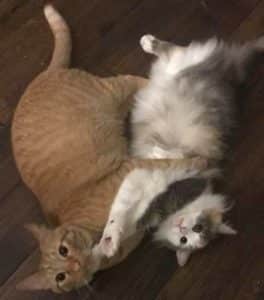
Adding tall cat trees and cat cubby hole hiding spots will usually help alleviate aggression over territory and space. Also, be aware that to a cat, you are their territory as well, so be sure to give each of your cats love, attention, and playtime every day to help avoid jealousy. At night, my cat Punkin has claimed the space next to my head for himself. If any other cat is in his spot, he will get a swat from Punkin. (this is Punkin in the photo, by the way!)
Calming the Aggressive Cat
 It’s important to tone down the aggression and calm your cat quickly before anyone gets hurt. Talk softly to your cat, but don’t try to pick him up or pet him during an aggressive episode. If this behavior happens frequently, trying adding calming music, or some calming flower essences to take the edge of his aggression.
 If your cat’s behavior is constantly aggressive, he should be seen by your vet to rule out medical causes for his behavior. Illness or pain can cause your cat to behave in an overly aggressive way, so be sure your cat has a clean bill of health before you decide he has a behavior issue.
Once medical issues have been rules out, it’s important to identify the cause of your cat’s behavior so you can find a solution. Does he want your attention? Is another cat trying to play too roughly, does he need a safe  place of his own to climb upon? Could he be seeing another cat outside that is upsetting him? Do you need to add another food dish at feeding time?
Usually one or two simple changes will solve the problem, once you identify the reason for your cat’s aggression. Once the problem is resolved, your kitty will go back to being the coolest cat around!
If You Need More Help…
 Book a Cat Behavior Session with Rita Reimers or explore the Cat Behavior Learning Library for more expert advice.
Need Help Solving Your Cat’s Behavior Problems?
Book a private consultation with Rita Reimers, Certified Cat Behaviorist.
Book a Consultation

We’ve had our cat since he was 2. He’s now 14 and is on meds for thyroid. He’s perfectly well behaved when my partner is around, but, for last years or so, as soon as I’m alone with him, he gets aggressive. He screams at me and backs me into a corner so I have to scramble over furniture to escape him. I can’t watch TV without him getting on the sofa and onto my lap. His tail fluffs out, he meows very loudly, shoves his face hard into mine and I daren’t move because if I as much as twitch a finger, he lashes out with his claws. I was once kneeling next to him and he leapt up, boxed my ears with his paws and knocked me flying. He doesn’t put his ears back or lash his tail. I honestly can’t understand his behaviour but it’s ruining my evenings and I spend half my time trying to avoid him. What’s going on?
Hi Lorna,
As cats age and start having medical issues, any pain or discomfort he has could definitely cause him to lash out. We have methods to calm these cats, so I would suggest setting up a free 15-minute pre consultation with Nicole, so she can talk about the issues you face and recommend the session that’s right for you while making you comfortable with our services.
Here is the link to our session page, so you can review the options we offer. The free pre-consult is the first link: https://ritareimers.com/cat-behavior-sessions/
Rita
When my bf moved in with my cat my cat really hasn’t been happy, they’ve been fully separated and still trying to get them slowly introduced but now my cat is aggressive even in her own room (our room) what do we do
Hi Kati,
You’ve some to the right place, integration is our speciality. I live with 18 sanctuary cats, and Linda lives with 12. We’ve got the secret cause to helping cats to get along, or at least peacefully coexist.
I would suggest setting up a free 15-minute pre consultation with Nicole, so she can talk about the issues you face and recommend the session that’s right for you while making you comfortable with our services.
Here is the link to our session page, so you can review the options we offer. The free pre-consult is the first link: https://ritareimers.com/cat-behavior-sessions/
Success is right around the corner, we can help.
Rita
I recently rescued an outdoor stray or feral 8 years I’ve been feeding her, was TNR’d by the no kill rescue I volunteer at. I am good socialiing cats, had grown up with many all my life. My rescue and I took in 30 cats 8 yrs ago, and her kittens 8 yrs ago. She is here at my work in Pasadena. its not safe here anymore, Landlord won’t let me feed (do in secret), a mean feral we cannot TNR, tries to attack her, she lived in a tree. Coyotes now here all the time. After all these years just following me, meowing, wanting attention constant, now she was really running to me for affection, love, she went into my carrier I have in my trunk. I was fully petting her and she wanted to seek cover under me. She received clean bill of health, dewormed, deflead, boosters, etc. I have a one bedroom apartment with 2 other rescue cats I got them very young tho, sooo sweet. My stray as she appears abandoned 8 yrs ago, people around here told me, she is in a very large 5.5 ft crate many levels, I’ve let her out many times but it caused anxiety to put her back. I have just ordered an indoor catio for her so she can better acclimate. I scent swap, she has attacked those items, then sat on them ok. Sometimes appears good with my resident cats, sometimes don’t think so she gets upset if they want to see her sometimes. I give them all treats together she loves, hers goes on a chopstick end. She will purr like crazy, then like this morning she swatted me, scratched my finger putting her food in. She vies for my affection and sees me when I’m home, have her 5.5 ft tall crate by sliding door to see all the critters. I try to play with her (think she is learning but she is pretty wild in play), i pet her and she purrs, then next day all a sudden she is soo mad at me. She swatted my sweet resident cat, so I went back a step only visual. I just don’t know how to make this work when I have no spare room, but I have a nice indoor catio to build that I just ordered. I want to cry sometimes, don’t know how to help acclimate her. I have Feliway plugged in all over too. My one cat seems a little afraid of her. I’d never put her back to my work property, its also been 2.5 months now. Please Help me. I also have one of her babies now age 7.5, but neither know it of course, LOL. I could use your help
Hi Julie,
BLESS YOU for all you do for the cats! I used to live in Los Angeles, and I know the dangers those outdoor cats face.
Linda and I each have a former feral cat that we integrated with the other sanctuary cats. Integration and peaceful coexistence is our special gift.
I would suggest setting up a free 15-minute pre consultation with Nicole, so she can talk about the issues you face and recommend the session that’s right for you while making you comfortable with our services.
Here is the link to our session page, so you can review the options we offer. The free pre-consult is the first link: https://ritareimers.com/cat-behavior-sessions/
We look forward to helping you ocheive peace.
Rita