A Quick Guide to Common Cat Behaviors
by Certified Cat Behaviorist Rita Reimers
Updated for 2025
 Cats are endlessly fascinating. One moment, they’re snuggled in your lap, the next they’re sprinting across the room as if chased by invisible prey. To the untrained eye, feline antics can seem puzzling, but every whisker twitch and tail flick is part of a bigger story.
As a certified cat behaviorist (ABCCT) and proud cat mom to 16 rescue cats, I’ve spent over 20 years helping cat parents decode the mysteries of cat behavior.
Once you understand your cat’s instincts, communication style, and emotional needs, you’ll find that life with your feline becomes more harmonious, less stressful, and a whole lot more fun.
Please Bookmark this article – I will be adding links to articles further describing the behaviors here
What Is Cat Behavior?
 Cat behavior refers to the instinctive and learned actions that cats use to survive, communicate, and interact with their environment.
Unlike dogs, cats evolved as solitary hunters, which means their behavior is rooted in self-sufficiency, territory, and subtle communication.
- Understanding cat behavior matters because:
- It helps you tell the difference between normal actions and problem behaviors.
- It strengthens the bond between you and your cat.
- It prevents misunderstandings that lead to stress or surrendering cats to shelters.
The Language of Cats: Decoding Everyday Behavior
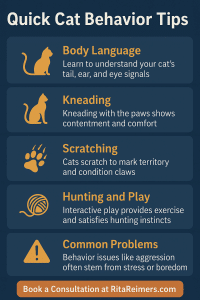 1. Play and Hunting Instincts
Even the sweetest housecat has the heart of a hunter. Chasing toys, stalking your feet under the blankets, or “pouncing” on shadows is part of their natural predatory drive.
Daily play sessions mimic hunting and keep your cat physically fit and mentally stimulated.
2. Body Language and Signals
- Tail up = confidence and friendliness.
- Slow blink = trust and affection.
- Flattened ears = fear, overstimulation, or aggression.
- Arched back with puffed fur = defensive posture.
3. Vocalizations: The Cat’s Voice
 Meows: surprisingly, cats don’t meow to each other—only to humans!
- Purring: usually contentment, sometimes self-soothing when anxious or ill.
- Chirps/Trills: friendly greetings or excitement when ‘talking’ to prey.
- Yowls or Growls: discomfort, fear, or territorial warnings.
4. Territory and Scent Marking
- Cats define their world through scent. Rubbing cheeks, scratching posts, or even spraying are ways to claim territory.
- Scratching also maintains healthy claws and stretches muscles—so it’s a need, not a ‘bad habit’.
 5. Sleep and Routine Habits
Cats sleep 12–16 hours a day because in the wild, conserving energy between hunts was crucial. They thrive on predictability: feeding, play, and bedtime routines help lower stress. (My PEGS Routine)
 Problem Cat Behaviors and Their Meanings
- Litter Box Issues: may signal medical problems or environmental stress.
- Aggression Between Cats: often fear-based, territorial, or redirected aggression.
- Furniture Scratching: natural behavior; redirect with scratching posts and cat trees.
- Nighttime Zoomies: cats are crepuscular (most active at dawn and dusk).
- Excessive Meowing: attention-seeking, boredom, or an indicator of pain in senior cats.
 How to Correct Cat Behavior Problems
- Provide Enrichment: rotate toys, use puzzle feeders, add scratching posts.
- Create Vertical Space: cat trees, window perches, and shelves.
- Play Therapy: daily interactive play mimics hunt-catch-kill-eat cycle.
- Consistency and Patience: cats don’t respond to punishment. Use positive reinforcement.
When to Call a Cat Behaviorist
Sometimes, despite your best efforts, issues persist. That’s when professional help makes the difference. As a cat behaviorist, I’ve worked with thousands of households to stop litter box problems, reduce fighting, and help newly adopted cats adjust.
Understanding Cat Behavior Strengthens Your Bond
 Cats aren’t aloof or unpredictable—they’re just speaking a language we must learn to understand. By respecting their instincts and addressing issues with patience, you’ll build a bond that lasts a lifetime.
If you’re struggling with cat behavior problems, you don’t have to figure it out alone.
Need More Help?
👉 Book a Cat Behavior Consultation with Rita Reimers – Rita has been Restoring Harmony in Cat Households Since 2003.
Need Help Solving Your Cat’s Behavior Problems?
Book a private consultation with Rita Reimers, Certified Cat Behaviorist.
Book a Consultation

We have a two year old Longhair calico female that has attitude.Ive tried to introduce another cat I was wanting to add to our family twice but our girl goes mean.if a stray looks in the door our cat gets mad at us for days.she peters my daughter.she comes to me for food and treats and that’s it.Id love to hold her but can’t.she hates hugs period.its on her terms for attention she hates visitors runs and hides. Can her ways be improved?
They can! We would need more information but I would bet your kitty has high anxiety. Being hugged, etc puts kitty in a very vulnerable position. If a cat has higher anxiety they won’t want to be in that kind of situation.
If you want to do a session, put as much detail into the email as possible so we can work to fully understand her issues and make a plan. Then when we talk we will fine tune it with you and get you going forward!
My cat meows a lot and has been running around like a squirrel…..She has an upcoming appointment because she had a urinary infection in December……Background….She’s 4 and I adopted her in June 2020. We moved to Seattle in Dec 2020. I planned to move back to Virginia in 2021 because I didn’t like Seattle. My cat lived with my parents for 3 months in Chicago ahead of my intended move back to Virginia…. We’re now back in Virginia…. Just us living in my apartment
I love Virginia! It’s so beautiful! Congratulations on your move.
I’m glad you are starting with a vet visit. There are medical possibilities for this. Pain can cause this behavior certainly. If you get a clean bill of health from the vet, it may be behavioral.
Being ill can cause stress which can lead to behaviors. Even if the UTI is cleared up, the memory of the pain can lead to anxiety.
Without knowing all of the details I’d suggest as much routine as possible. We would have to determine what kitty is seeking and what leads to this behavior. Keeping a journal of when it happens, what happens and what happened immediately before would be helpful.
Remember if you need help you can request a session. Give as much detail as possible on the form because we take time to read and share our thoughts ahead of our session to be as prepared as possible.
Hi! I am so thrilled to find your site. My cat has an extremely troublesome habit. He is 4 years old, and at random times of the day knocks things off the counters and cabinet where he eats. We have been working very hard to be consistent with a schedule for feedings, but the constant breaking of household goods is really dangerous and stressful. It is creating issues with human relationships in the house as well. Thanks for any insight!
Hi Janet!
Cats love knocking things over, but this sounds like an extreme habit he has developed. Has he always been this way, or is this a relatively new behavior? Stress can cause cats to act out in various ways, this might be one of them. Hi age could also be a factor (is he a kitten or young adult) as does his level of activity during the day. Is he bored perhaps? We’d love to know more. Feel free to schedule a free 15-minute pre-consultation so we can talk about his habits and see if a session could help.
https://ritareimers.com/cat-behavior-consultations/
Purrs,
Rita
My cats are the best of friends. However, when my babygirl, Bubbles, goes into heat and comes out of heat, the male cat, Blueberry or Blue-cifer is what we call him, will be very aggressive towards her. Last night he kept biting her and bit so hard on her ear that he ripped a piece of fur off. Will fixing my female help? Or what can I do? Blue is fixed.
Hi Jessica,
The mating urge in cats is crazy strong, and even though Blue is fixed, he still has the same instincts. So, when your girl Bubbles goes into heat, it makes him go after her. And mating in cats is violent and not at all tender…
I would suggest getting Bubbles spayed as soon as possible. Not only will it stop Blue from his aggressive behavior toward her, but it will help Bubbles, too. Going into heat is not pleasant for females, as cute as she may look when she is presenting herself and being all sweet. Also, you will cut out any chance of her getting Uterine Cancer, Pyometra, and a host of other issues that come along with the female reproductive system.
Purrs,
Rita
Our 4yr old rescued Snow Leopard Bengal has 2 distinct mood swings. In his igloo and sometimes out of it he will enjoy fuss and roll on his back to have his belly tickled which leads to head bunting and rubbing up against ones legs. He is obviously happy in this mood. When he is out of his igloo he is generally . unapproachable most of the time and runs off if you try.
He gives the impression he has been mistreated in the past and may have been castrated as a rejected stud cat as he appears to have strabismus, nor does not want to go outside We are at a loss as to how to proceed with any treatment and would be grateful for some advice.
Hi David,
Bless you for rescuing this kitty, I bet he is gorgeous!
How long has he been in your household, and do you have other cats or other pets? It does sound like he may have been mistreated or simple neglected in the past, and although he wants to trust you, his fear overwhelms him at times.
I would suggest setting up a free 15-minute pre consultation with Nicole, so she can talk about the issues you face and recommend the session that’s right for you while making you comfortable with our services.
Here is the link to our session page, so you can review the options we offer. The free pre-consult is the first link: https://ritareimers.com/cat-behavior-sessions/
We can help your kitty build confidence and trust in you and his surroundings.
Rita
This article is incredibly helpful! I love how it explains cat behaviors like scratching and aggression, giving reasons behind actions. The suggestions for enrichment and vertical space are great, and knowing when to consult a pro is super useful.
I am glad this article was helpful to you and your kitty!
I have a 8..10 month old outside cat that was left behind. She has adopted me. Lol. I never had cats before. I am new to everything about cats. I’ve been reading a lot, which has helped. There is one thing that I can’t find an answer for. While I’m sitting, she stretches up with her paws and touches my face. Granted, she does not want to be on my lap. I’ve tried. She is very uneasy on my lap and jumps off. What does she mean by touching my face with her paws?