Understanding cat sounds is key to telling how your cat is feeling about a situation. Cats have an entire language of sounds and body postures they use to communicate with one another. The trick is learning how to listen and observe the entire conversation, instead of reacting to one hiss or growl.
By Rita Reimers, Cat Behaviorist
 A Hiss is Just a Hiss…
If you live with more than one cat, chances are you’ve heard a hiss or two. Maybe even a growl. And if you’re in the process of introducing cats, hearing those sounds can be downright alarming.
But before you panic, remember this:
A hiss isn’t a fight. In fact, a hiss may be a cat’s attempt to avoid one.
A hiss is sometimes an expression of discomfort, but other times it’s a declaration of war. Understanding those cat sounds and their meaning, along with watching nonverbal communication gestures at the same time, will tell the full story of what is really happening.
What is the Meaning of Hiss?
 A hiss is usually a warning. Your cat may be frightened, uncomfortable, startled, or simply telling another cat, “You’re close enough. Back off.”
Sometimes it happens the first time to cats meet, sometimes if one cat isn’t in the mood to play it will happen. That’s communication, and most cats understand it very well.
NOTE: if you have a cat that was separated from mom cat and his litter mates very young, he may not yet understand cat communication. See my Catster article: Socializing Kittens
Does a Hiss Mean a Fight Will Happen?
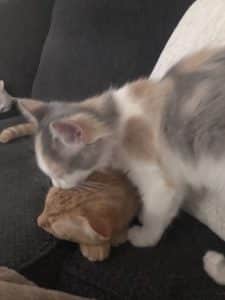 Understanding cat sounds can be challenging. Just because a cat hissed it does not necessarily mean a fight is imminent. In fact, cats generally don’t want to get into a physical fight. Fighting carries the risk of injury, so warning sounds and body language give them an opportunity to settle their differences without things becoming physical.
If one cat hisses and the other cat backs away, the communication worked.
This is particularly important during cat introductions. People often hear a hiss and immediately assume the introduction is failing. But some hissing and even growling can be a perfectly normal part of cats figuring out their boundaries.
What If My Cat Hisses at Me?
A hiss can also be a warning to us that the cat does not want to be touched or is generally unhappy at the moment. But just like with cat-to-cat communication, it is not true in every instance. Again, watching their body language will provide additional information.
An example of something I experienced when I owned Just For Cats Pet Sitting. I was looking after a cat who was somewhat feisty and not eager to accept strangers. When the cat decided I was sage after all and that he wanted attention, he would rub all over my legs as if he wanted to bet pet. But as he was doing this, he was also hissing! Contrary signals indeed. I ended up sitting down and letting him decide to jump up and seek physical affection, but it was quite confusing at first.
Hissing and Growling Can Be Warning Shots
 I often tell my clients to think of hisses and growls as warning shots.
They frequently come from fear, uncertainty, or discomfort. Your cat isn’t necessarily saying, “I’m going to attack you.” More often, they’re saying, “I’m not comfortable with this. I don’t trust you yet. Give me some space.”
Panicking at every little hiss or growl is stressful, especially when first introducing cats. Well-meaning humans sometimes interrupt the setting of boundaries and hierarchy by intervening too quickly. It’s understandable, but I try to prepare my client to accept that there will be some warnings issued between the cats.
Read Successful Cat Introductions: How Can I Tell If We Are Done? for more details.
Instead of just listening, also observe the cat’s body language.
What are the cats’ bodies telling you? What happens after the warning? Does the other cat back away? Does everybody settle down? Or are the sounds and body language becoming more intense?
Those details tell you far more than the hiss alone. Ready to understand cat sound progression?
The Progression of Cat Warning Sounds
 The noises cats make when agitated follow a general hierarchy, starting from a gentle warning and culminating in an actual fight if those early signals are not heeded. When a cat feels increasingly threatened, the sounds will often escalate roughly like this:
Hiss → Growl → Snort → Yowl → Scream →Spit
A hiss is toward the beginning of the warning system. As the vocalizations become louder and more intense, your cat is telling you that their level of distress is increasing.
I generally don’t want an encounter to reach the snort stage, which is the start of a yowl. By then, the cats are moving beyond those early warning shots and the risk of escalation is becoming greater. Once we get beyond a low growl, if one cat isn’t backing down then it’s time for we humans to stop the progression. But don’t pick up either of the cats, just guide one of them away to stop the fight from happening.
The goal isn’t to prevent cats from ever expressing discomfort. It’s to recognize what they’re telling you before the conversation turns into something more serious.
Please read Don’t Pick Up an Angry Cat for idea about stopping a budding cat fight.
Listen to the Sounds, But Watch the Cat
 Never evaluate a cat interaction based on sound alone. They key to understanding cat sounds is to alway watch their body language. A cat’s body language gives you the other half of the conversation.
Watch the ears, eyes, tail and overall posture. A cat whose ears are flattened against the head, pupils are very large, and tail is low or puffed up is giving you much more information than a hiss by itself.
When you see flattened ears, large dilated pupils, a low and/or bushy tail, and increasingly intense vocalization together, pay attention. These are unmistakable signs that a fight may be brewing.
On the other hand, one hiss followed by the cats creating some distance and settling down may be nothing more than successful feline communication.
Try not to judge the interaction by one sound. Rather, read the entire conversation.
What About Cats Who Are Playing?
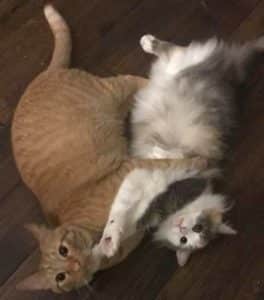 Play usually looks and sounds quite different, although some hissing, growling, and a few other sounds may ensue.
Cats who are happily playing generally have relaxed bodies. Their ears are more likely to be straight up and pointed forward, and you’ll often see friendly tail in the up positions. They may chase, wrestle, pounce and tackle one another in ways that look surprisingly rough to us.
Play can occasionally become too intense, however, and that’s another reason observation matters so much. One cat may decide they’ve had enough roughhousing, while the other wants to keep going.
If you notice one cat’s tale begins to thrash back and forth rapidly, and/or if one cat cannot get out of the grip of the other, it’s time to put an end the their playtime for the moment.
If you’re unsure whether you’re watching play or an actual fight, take a look at my article Are My Cats Playing or Fighting: How to Tell the Difference. There are clues that can help you tell the difference.
Cats Have Happy Sounds, Too
 Of course, feline vocalization isn’t all about warnings.
Cats purr, meow, chirp, chatter and make those wonderful little murmuring sounds when they’re content, excited, greeting us, watching prey through a window, or simply communicating with the people and animals around them.
Some cats are extremely talkative while others will barely make a sound. I have both types of cats in my household.
Over time, you’ll learn your own cat’s particular vocabulary and what each little sound means. You may even recognize different meows depending on whether your cat wants dinner, attention, a door opened, or simply wants to know where you are.
A Hiss Really Can Be Just a Hiss
 Understanding cat sounds is the key to learning how cat communicate. The next time your cat hisses, resist the urge to assume something terrible is about to happen. Stop. Listen. Observe.
For true understanding of cat sounds, you should also also know: What happened immediately before the hiss? What is your cat’s body telling you? What does the other cat do in response? And most importantly, does the situation settle down, or does it continue to escalate?
A hiss is just information being communicated, it does not always culminate in a fight. Your cat is communicating a boundary in a gentle way, but cats will communicate more forcefully if the hint goes unheeded.
And sometimes, a hiss really is just a hiss.