By Cat Behaviorist Rita Reimers
What to Know About Cat Bites and Scratches

We love our cats, and often our first reaction when a cat is scared is to reach down and comfort them. Likewise, when cats are fighting, we want to jump in and separate them as quickly as possible before anyone gets hurt.
However, there’s a very good chance that you may be the one who gets hurt.
Your cat does not mean to hurt you, but an upset cat’s instinctive reaction is to protect themselves. In the middle of a fight or moment of panic, your cat may not even realize it’s you they’re biting or scratching.
Cat bites can be serious business. Don’t Pick Up and Upset Cat!
Why Do Cats Bite and Scratch

Almost everyone instinctively picks up a frightened or upset cat. We want to comfort them and help them feel less afraid. However, cats instinctively bite or scratch for a variety of reasons:
- To catch prey
- To communicate boundaries
- If they are scared
- If they are in pain
- To ensure their survival
- Redirected aggression or frustration
It’s important to note here, that your cat is not trying to hurt you. In nature, cats are both predatory (hunter) and prey (hunted). Cats retain the survival instincts of their wild ancestors, including a strong instinct to protect themselves, their territory, resources, and sometimes even the humans they are bonded to.
In moments of fear, conflict, or overstimulation, a cat may react instinctively before fully understanding what they are biting or scratching. A scared cat biting is not the same as an aggressive cat attacking.
What Makes Cat Bites Dangerous

Whether intentional or accidental, cat bites can be quite dangerous. Cats teeth are razor sharp. They look like little needles, with their long, thin shape. And just like a needle, those teeth inject whatever is on them straight into your flesh.
Moreover, the punctures are so thin that they often close up right away, sometimes without even bleeding. That means any bacteria on a cat’s teeth are now sealed up inside your arm, especially if there is no bleeding that would normally push the bacteria out
While we are predominantly focusing on cat bites here, cat scratches can also become infected as well.
Common Bacteria in Cat Saliva
Cat mouths host over 200 different strains of bacteria, the most common and dangerous of which is Pasteurella multocida. This is present in up to 90% of healthy cats. Other bacteria present may also include Streptococcus, Staphylococcus, and Bartonella henselae.
According to VCA Animal Hospitals: “Roughly 50% of cat bites result in an infection, which typically requires prescription antibiotics.”
What to Do If you are Bitten
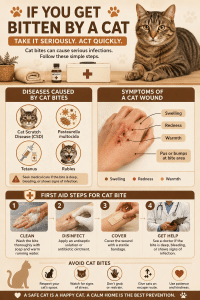 The first think I suggest is to immediately wash the bite in hot water and antibacterial soap. Put some anti-bacterial cream on it and keep an eye on the wound.
Infections usually show signs within the first 12 hours of the bite. If you experience any of the following, seek medical care immediately.
- Redness around the wound
- Swelling
- Tenderness when touched
- If the wound feels warm
- You see pus
- If you experience fever or chills
When to Seek Immediate Medical Help – this is important!
You should seek immediate medical attention at urgent care or emergency room if:
- The bite is deep or on a joint (on the hands or wrist especially)
- There are signs of a spreading infection or fever
- If you are immunocompromised, have diabetes or circulation issues
- It’s been more than 5 years since your last tetanus shot
Waiting could have serious consequences. Left untreated, these bacteria may cause rapidly spreading skin infections such as cellulitis. Untreated bite wounds may even cause life-threatening blood poisoning, such as sepsis.
How to Handle an Upset Cat
There are some much safer ways to handle a cat that is upset, especially when breaking up a cat fight. I don’t normally suggest using water bottles, since your cat won’t learn what you want and may even begin to fear you. However, in extreme situations where safety is at risk, by all mean use the water bottle.
Here are some better ways to handle upset cats.
How to Calm an Upset Cat

When a cat is scared or angry, his fight-or-flight instincts kick into overdrive. Some cats will hide, but a good majority of them are ready to defend themselves tooth and nail.
In both cases, avoid direct eye contact. Eye contact is perceived as a threat to cats, and he may decide its time to fight. Give your cat some space, don’t crowd him or linger overhead.
Talk in a calm soothing voice and move slowly. Leave him alone to let him cool down in a quite place. Its also important to not yell at or punish your cat for his natural instincts and behavior.
Safe Ways to Break Up a Cat Fight
Again, don’t pick up and upset cat. Here is where I stress in my cat introduction sessions to please not reach between two fighting (or perceived to be fighting) cats. You may well get bitten, not because your cat wants to bite you. If you get bitten, it’s because you got between him and the other cat as he was about to bite.

You may thing, “good, better me than the other cat” and sure I understand that logic. But given how medically dangerous cat bites can be, there are other less invasive ways to stop the fight, often before it even starts.
- Teach your cat “Whiplash Turns” so you can distract him while he is winding up to pounce.
- Shake a can of pennies or make another sudden noise that causes the pursuing cat to stop
- Toss the chaser a toy, toss it just ahead of him so he has to stop and investigate, giving the other cat time to retreat
- Throw a blanket or towel over them, even if they are already in combat. Instinctively, the cats will work to get themselves free and stop fighting.
- Put a barrier between them to break their view of each other, such as a large pillow or even a large piece of cardboard.
- Only if you have no other recourse, use a water bottle to stop a fight before anyone gets hurt.
So – Now You Know – Don’t Pick Up an Upset Cat
Save yourself and your cat the conflict and tension, as well as medical bills and/or vet bills. Your cat is not trying to be “bad.” An upset cat is reacting instinctively to fear, stress, pain, or perceived danger. Now that you know other ways to deescalate the anxiety and fear, don’t pick up that upset cat.
Need Help with Your Cat’s Behavior?
Rita Reimers provides judgment-free virtual cat behavior consultations for litter box issues, aggression, introductions, anxiety, and more.
Book Your Private Session with Rita
Leave a Reply