Grooming Behavior Explained
by Cat Behaviorist Rita Reimers

If you’ve ever wondered why cats lick each other, it’s actually a behavior called grooming, or allogrooming. Allogrooming, is a common and typically affectionate behavior between bonded cats.
It’s one of the ways felines reinforce social bonds, show trust, and keep each other squeaky clean (or, you know, as clean as a cat needs to be). If you’ve ever watched your cats tenderly licking each other, you’ve probably melted a little at the sweet display.
But sometimes, this “adorable” behavior can cross into murkier territory—what starts as gentle licking can signal dominance.
So, when does mutual grooming become something more than just friendship? Let’s dive into the subtle world of cat dynamics to decode when that loving lick says, “I care about you”… and when it says, “I’m the boss here.”
Not Sure If Your Cats’ Grooming Is Normal?
When licking turns into dominance, stress, or tension, it may be a sign of a deeper relationship imbalance. Let’s decode what’s really going on and restore calm in your home.
What is Mutual Grooming (Allogrooming)?

Cats are naturally clean creatures, and grooming is an essential part of their daily routine. Mutual grooming involves one cat licking another, often on hard-to-reach areas like the head, neck, and face. It’s a social bonding ritual, seen frequently between littermates, bonded pairs, or cats who have established trust with one another. This behavior releases endorphins, reduces stress, and helps build positive relationships.
In most cases, mutual grooming is a sign of harmony. But as with all cat behavior, context matters—and when power dynamics are involved, things get a little trickier.
The Dominance Connection
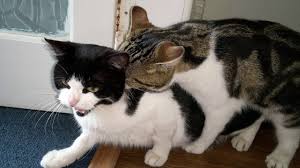
Cats are often thought of as solitary creatures, but they are capable of forming complex social structures. When living together in multi-cat households, they naturally create a pecking order—even if it’s subtle. Mutual grooming can sometimes reflect that hierarchy.
Here are some signs that mutual grooming may have shifted from affection to dominance:
- One Cat Always Initiates the Grooming
If one cat consistently grooms the other without ever being groomed in return, this can indicate a power imbalance. The “groomer” may be asserting its role as the more dominant cat. - The Grooming Cat Restrains the Other
Ever notice one cat pinning the other’s head down during grooming? It might look like a cuddle, but it could also be a subtle sign of control. This behavior can escalate into holding the other cat in place, even when the recipient tries to move away. - Grooming Turns Into Biting or Aggression
What starts as licking can sometimes shift into nipping, biting, or a scuffle. This transition often signals dominance, especially if the grooming cat gets aggressive when the other cat tries to leave. - The Groomed Cat Looks Annoyed or Submissive
If the cat being groomed looks tense, tries to wriggle away, or crouches with its ears flattened, the grooming may not be so welcome. Cats under the “dominant” grooming often tolerate it because it’s easier than fighting back. - Other Dominant Behaviors Accompany the Grooming
Dominance doesn’t exist in a vacuum. If the same cat that’s doing all the grooming also monopolizes food bowls, favorite nap spots, or demands attention from humans, the grooming is likely part of its overall dominance display.
PRO TIP: Are your cats becoming aggressive during allogrooming?
Get our 6 Tips for Calming Anxious Cats With Behavior Problems
Why Does Dominant Grooming Between Cats Happen?
Cats establish dominance to maintain order and avoid conflict. While this behavior may sound negative, it’s a natural way for cats to communicate boundaries and establish roles in their little social circle.
Here are a few reasons dominant grooming happens:
- Stress or Changes in the Environment: Cats often reassert hierarchy during times of change, such as introducing a new pet, moving homes, or even changing routines.
- Reinforcing Bonds and Rules: Dominant cats may groom others as a way of saying, “We’re cool, but remember who’s in charge here.”
- Mimicking Kitten Behavior: Mother cats groom their kittens to clean and comfort them. Dominant grooming can mimic this behavior, positioning the “groomer” as the caretaker or leader.
When to Intervene

For the most part, dominant grooming between cats doesn’t escalate into anything harmful. However, if you notice your cats becoming stressed, annoyed, or aggressive, it may be time to step in.
- Separate the Cats Temporarily: If one cat seems overwhelmed, give them a break by separating them into different spaces for a while.
- Provide Plenty of Resources: Ensure there are enough food bowls, water dishes, litter boxes, and resting spots to reduce competition.
- Redirect Energy: Play with your cats regularly to help them release pent-up energy and stress. Toys and puzzles can keep them stimulated and relaxed.
- Reward Positive Interactions: Praise or treat your cats when they engage in gentle, mutual grooming without signs of dominance.
Final Thoughts on Grooming Between Cats: Balance is Key
Mutual grooming is often one of the sweetest and most heartwarming aspects of a multi-cat household. But as with any cat behavior, it’s essential to observe the dynamics and ensure everyone feels comfortable and respected.
If you start to notice that grooming has become less about love and more about control, it’s a good opportunity to monitor their interactions, provide enrichment, and keep the peace. At the end of the day, harmony in your feline family is all about balance—and a little bit of cat-parent vigilance.
So the next time you see your cats locked in a grooming session, take a closer look. Is it love? Is it dominance? Or maybe it’s just one cat saying, “You missed a spot.”
Need Help with Your Cat’s Behavior?
Rita Reimers provides judgment-free virtual cat behavior consultations for litter box issues, aggression, introductions, anxiety, and more.







10-year-old 8 pound male and 6-year-old 13 pound female arrived at my house three months ago. According to the owner, neither had even been to a veterinarian. That evening, I quickly determined something was amiss with the female because of her aberrant behavior; I took her to an emergency clinic where she was diagnosed with severe hydrometra so I had her spayed; she was at the clinic for three days. While she was gone, the male paced around the house, apparently looking for her. Following her return, she was fractious, hissing and growling constantly. (In addition to her rocky beginning at my house, she now had the incision to contend with as well as a soft Elizabethan collar.) After 10 days I removed the collar, expecting it might relieve the situation…she continued to be “disagreeable”. On the other hand, the male, who had begun sleeping with me the first night, continued to “care for her”, making sure she had opportunities at the litterboxes, the food dishes, and sleeping quarters. One evening, watching her I began to wonder if she was jealous, so I caught her and began “force petting” her despite her growling and hissing. Because she never made an attempt to bite or claw, I thought I would risk it. Within two episodes of “force petting” she became very affectionate and now jumps into my lap, lays on my chest and purrs, touches noses, etc. No more growling and hissing at all. A new problem has arisen now. The two now walk around together, eat forehead to forehead and side by side, and even sleep together. The problem: they often mutually groom each other for minutes; however, after a time, the female suddenly begins biting the male — hard enough for him to cry out — and with her heavier weight, falls on him and pins him to the floor. While I can intervene when I see this, I work for 12-hours periods, and I worry about this behavior when I’m away. Apart from separating them during the day (and she is a master at getting pocket doors open), is there something I can do to make certain he is safe?
Hi Diane,
You’re wonderful to take these kitties in, and i am glad you got her spayed. Pyometra can be very serious if not take care of quickly. It does take some time for hormones to settle after a spay or neuter, so she likely was reacting to hormonal fluxuation when she first came home. Great news you were able to rekindle a relationship with her.
As for the grooming issue – While mutual grooming (allogrooming) if often bonding, it can turn into conflict due to overstimulation or as an assertion of dominance. In this case, it sounds like she does not like to be groomed for a long period of time. She may signaling for him to stop via her body language, and if he doesn’t pick up the signs she then will bite to get him to stop. Of course, intervene with a loud clap and telling her to stop if/when she gets to rough. Also using calming aids like Rescue Remedy may also help her remain calmer overall and less prone to biting to signal that she has had enough grooming.
Let me know how things progress.
Rita
Hi there!
We adopted two bonded 1.5-year-old cats three months ago. They were originally neglected on a farm, then taken to a shelter, adopted by another family, and ultimately rehomed to us due to allergies. We were informed that the female had a history of inappropriate urination.
During the first two months in our home, her accidents were occasional and probably related to the stress of the new environment. Over the past month, however, the frequency has increased significantly. She now urinates on soft surfaces (mainly blankets) up to six times per day. The past week has been particularly intense with 2–3 times per day outside the litterbox. After restricting access to the bedroom, the situation improved slightly, yet she continues to urinate daily on a tarp-covered couch. We have tried everything from pheromone diffusers, more litter boxes and even anxiety meds. The vet said that she’s perfectly healthy.
We noticed that the escalation seemed to coincide with her brother becoming more confident and affectionate with us (he was initially very shy). We suspect there may be a social or territorial component, possibly related to their bond and his increasing assertiveness. He may also be overstepping her boundaries. Today I noticed that allogrooming happened and led into a chase and fight, after which she attempted to pee on the couch again.
Do you have any advice on how to deal with this situation, since they’re bonded but also seem to get stressed with the hierarchy? I’m curious to get your insights.
Best regards,
Gretel
Hi Gretel!
Thank you so much for sharing all of this — you’ve clearly put a lot of thought and care into helping your girl, and I know how stressful this situation can feel.
From what you described, there are several things going on at once: stress, social dynamics shifting between the siblings, and possibly some anxiety around territory and resource access. When a bonded pair goes through a change in hierarchy or confidence levels (like her brother becoming more secure), it absolutely can trigger urination outside the box, especially on soft or owner-scented items.
Because there are multiple layers here — medical, territorial, and emotional — this is something that really benefits from a full behavior consultation. I’d want to take a closer look at their environment, their relationship patterns, and your home setup so we can create a plan tailored just for them.
I can definitely help you untangle what’s going on and put a step-by-step strategy in place to reduce her stress, support their bond, and get the urination under control.
If you’d like to work together, you can book a session with me here:
https://ritareimers.com/cat-behavior-sessions/
(I offer several options depending on what works best for you.)
You’re not alone — this is solvable, and I’d love to support you through it. 💛
Warmly,
Rita